

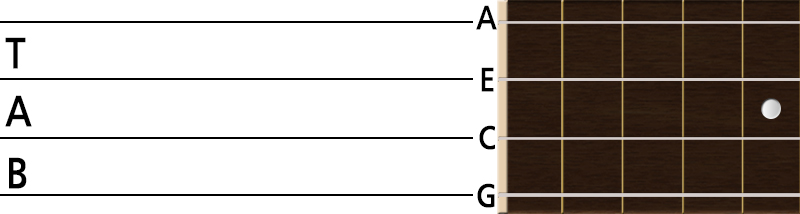
The first thing to understand is how the tabs relate to the strings of your ukulele.
The diagram above shows the tab diagram on the left and on the right is the strings diagram rotated to the left (the tuners and head of the ukulele would be pointing to the left).
Right Hand
The use of p, a, m and i is widely used in guitar music. The 4th finger is used in Flamenco for rasgueos and there is no standard symbol so I have used 'e' because that was the letter used when I was taught.
Left Hand
The numbering of the left hand fingers is quite straight forward and is sometimes used in tabs to explain further details.
Extra symbols
Arrows are used to show the direction of the stroke when strumming.
There are downstrokes and upstrokes.
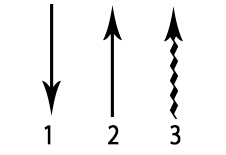
The straight arrows are used to show the strings are struck rapidly and the sound is a single beat.
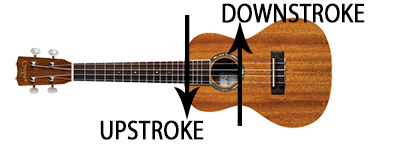
The image of the ukulele with the arrows overlaid should help with any confusion about the direction the stroke should be played.
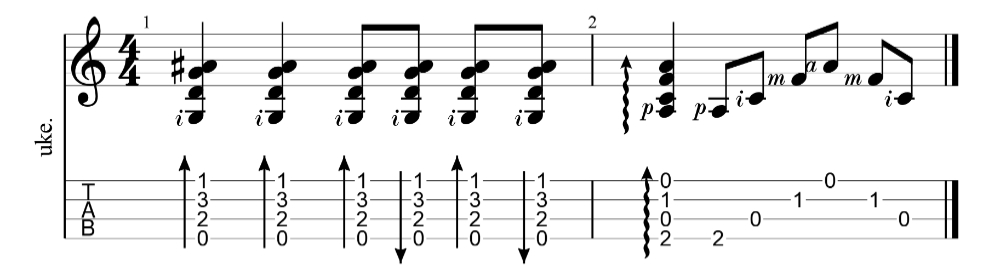
Bar 1
The bar starts with the time signature, which in this instance is 4/4 time (4 beats in the bar).
The chord used is Gm - 1st fret A string, 3rd fet E string and the 2nd fret C string are all stopped while the G string is played open - the first and second beats are played with a downstroke while the the third and fourth beats are eighth notes played with alternate down and upstrokes.
The sound clip below will give you an idea of the overall sound of both bars played together.
Bar 2
The first beat is the F chord and because of the wavy line it is played with each note of the chord sounding individually in quick succession.
Note that the chord shape is retained by the left hand for the next three beats but this time the notes should be played individually on the half beat. Letters are used to show which fingers to use while plucking or striking the strings.
The right hand fingering is my preference and can be altered to suit your style of playing, however, the use of the thumb on the base string can give emphasis to rhythm (not very noticeable here).